The balance of power in the technology sector is undergoing a dramatic shift. After years of absolute American dominance in the artificial intelligence landscape, current data suggests that China is no longer merely a pursuer, but is nearing a decisive lead in the "most important race of the twenty-first century." Despite Washington’s technical edge in foundational models, Beijing’s strategy—built on "ubiquity and
 physical sovereignty"—is beginning to bear fruit.
The real shift began a year ago, specifically in early 2025, when the Chinese company DeepSeek launched a high-performance Large Language Model (LLM) at a fraction of the cost spent by Silicon Valley giants like OpenAI and Google. This was not just a technical breakthrough; it was a manifesto for a new Chinese philosophy: innovating with maximum efficiency and fewer resources.
Today, the AI race is viewed as a long-distance marathon rather than a sprint. While the United States focuses on building the most powerful LLMs backed by advanced Nvidia chips, China is betting on overcoming technical hurdles and American sanctions by integrating AI into the heart of its real economy—finding alternative, unconventional ways to achieve equal or superior results.
Closing the Gap Despite Restrictions
The U.S. has long relied on its superiority in advanced computing hardware. However, analysts—including Leah Fahy from Capital Economics—point out that export restrictions have not stopped Chinese firms like Alibaba and Moonshot from narrowing the performance gap. Thanks to algorithmic efficiency and data quality, China has proven that smaller, smarter models can rival American behemoths.
In terms of human capital, China has significantly outpaced the U.S. In 2022 alone, China granted over 50% more STEM PhDs than America, while its researchers recorded three times the number of AI patents, creating a knowledge base that is difficult to disrupt.
The "Killer App": Embodied AI
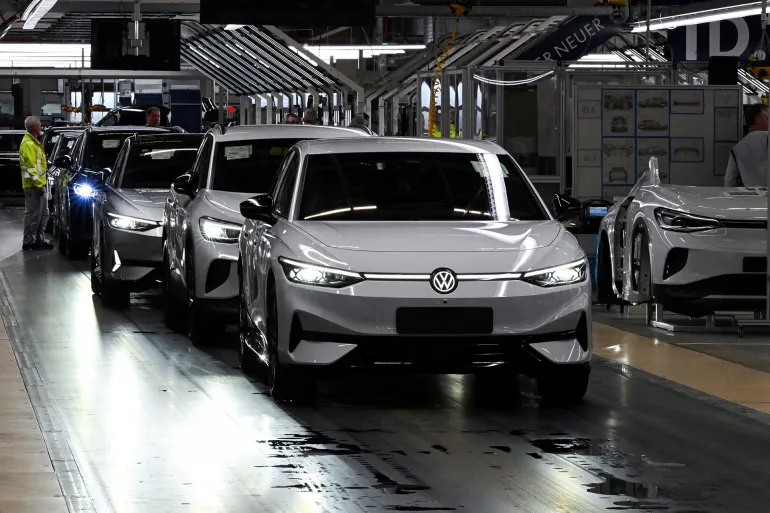
China's "lethal" strength lies in the concept of Embodied AI. While America excels in generating text and images, China thrives in placing the AI "brain" inside a physical "body"—be it a factory robot, a self-driving car, or a drone. China leads the world in the number of industrial robots per employee and currently dominates the supply chains for critical raw materials needed to build power grids and data centers.
With its superior engineering capabilities, China can build the necessary AI infrastructure at lightning speed. While constructing a data center
 in the U.S. might take three years, China possesses the regulatory flexibility and energy resources to scale within months.
The Energy Battle and Global Reach
Reports from Goldman Sachs project that by 2030, China could have a surplus electricity generation capacity equivalent to three times the expected global demand for data centers. This "energy abundance" will allow it to run massive computing hubs even if it uses chips that are less efficient than American ones—a decisive logistical advantage.
Internationally, Beijing is pursuing a "technical soft power" strategy through Open Source models. These free models empower developers in the "Global South" and emerging markets to build their own systems, independent of American cloud dominance. With companies like Huawei operating in over 170 countries, China is setting the technical standards that the world will follow tomorrow.
Conclusion
In summary, the United States resembles a sprinter with the best gear, but China appears as an integrated economic bloc building a comprehensive ecosystem. Technical dominance in 2026 and beyond will not be measured solely by who possesses the smartest language model, but by who can integrate that intelligence into daily products and services, and who possesses the energy and raw materials to sustain it. Analysts suggest that China is rapidly closing the innovation gap and possesses unmatched advantages in scaling and global distribution, making it the frontrunner for the title of the sole superpower in the AI era, according to the Financial Times.